
The 5 Trauma Responses: Why Your Nervous System Does What It Does
Fight, Flight, Freeze, Fawn, and Functional Freeze Through the Lens of Somatic Experiencing & Polyvagal Theory
Have you ever wondered why you react the way you do under stress?
Maybe you become irritable and defensive. Maybe you avoid difficult situations. Maybe you shut down completely and struggle to think clearly. Or perhaps you find yourself constantly taking care of everyone else's needs while ignoring your own.
Many people assume these reactions are personality flaws. They're not. They are nervous system responses, your body’s and brain’s ways of keeping you alive. Trauma and stress can be understood as what happened inside the body when an experience felt overwhelming, unsafe, or too much to process.
Your nervous system developed creative ways to protect you. Those protective responses may no longer be serving you today, but they likely helped you survive difficult moments in the past.
The good news?
Your nervous system can learn new patterns.
Trauma Lives in the Nervous System
When we experience stress or danger, our autonomic nervous system automatically works to keep us safe.
This process happens outside of conscious awareness.
According to Polyvagal Theory, developed by Dr. Stephen Porges, our nervous system is constantly scanning for cues of safety and danger. Depending on what it detects, it shifts into different states designed to help us survive.
Similarly, Somatic Experiencing, developed by Dr. Peter Levine, teaches that trauma is often stored as incomplete survival energy within the body. When a threat feels overwhelming, the body may become stuck in protective patterns long after the danger has passed.
These patterns often show up as the trauma responses we know as:
Fight
Flight
Freeze/Shut Down
Fawn
Functional Freeze
Let's explore each one.
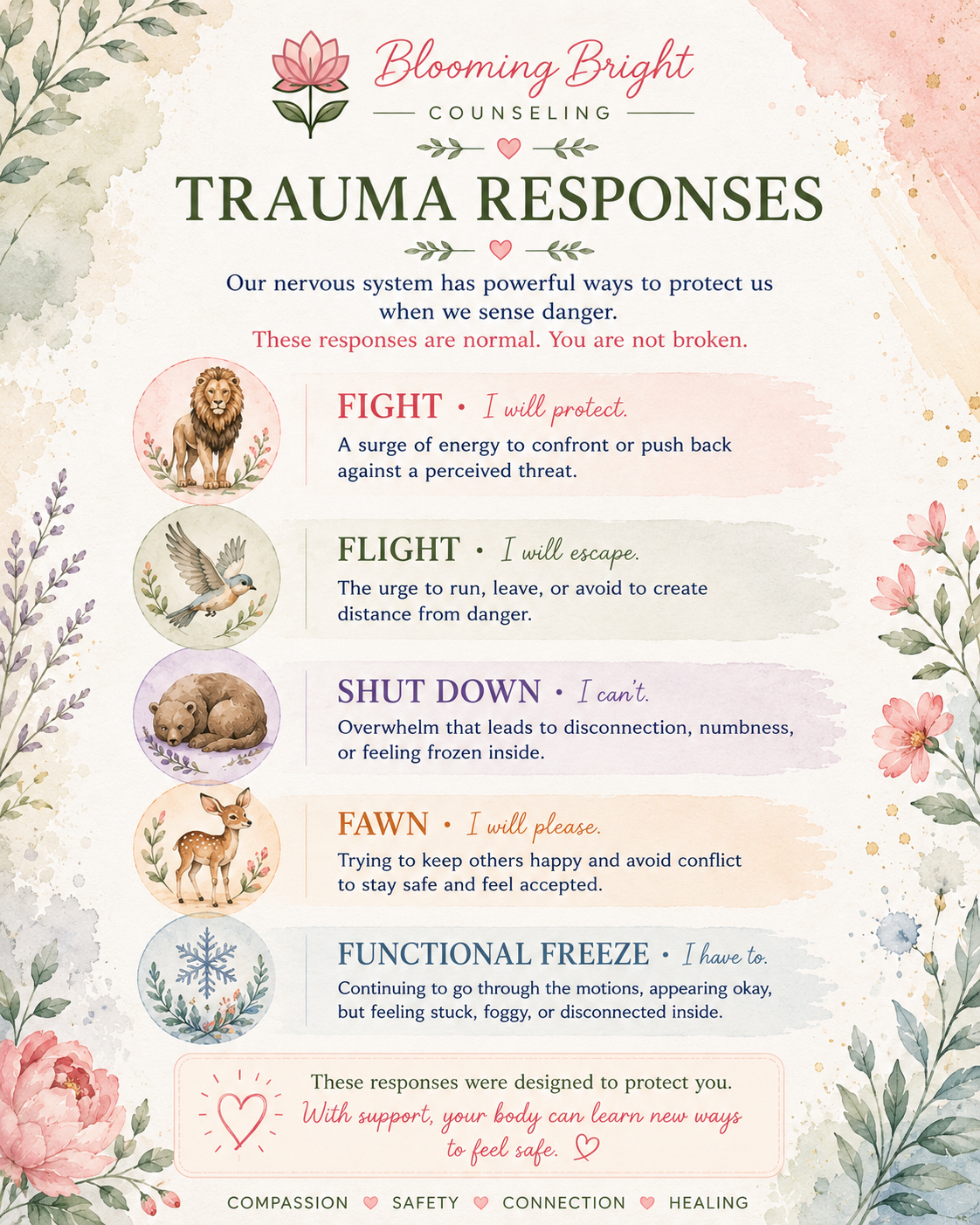
Fight Response: "I Need to Protect Myself"
The fight response mobilizes energy to confront danger.
People in fight mode may:
Become easily irritated
Feel defensive
Argue frequently
Experience anger or frustration
Feel controlling when stressed
Have difficulty backing down from conflict
From a nervous system perspective, this isn't about being aggressive; it's about protection. The body believes action is necessary to stay safe. The goal is not to suppress the energy but to help it move safely through the body.
Try This: Wall Push Exercise
Stand facing a wall.
Place both palms firmly against it.
Slowly push into the wall as if creating space between yourself and a challenge.
Notice the strength in your arms, shoulders, and legs.
Hold for 5–10 seconds, then release.
Take a slow breath and notice any changes in your body.
Reflection Prompt:
"What does it feel like to have strength without needing to fight?"
Flight Response: "I Need to Get Away"
Flight energy prepares us to escape danger.
People in flight mode often:
Stay constantly busy
Overwork
Struggle to relax
Feel anxious or restless
Avoid difficult conversations
Stay productive to avoid uncomfortable emotions
Many high-achieving adults unknowingly spend years in a flight response. From the outside they appear successful, but inside they may feel exhausted.
Flight energy creates an urge to move, escape, or stay constantly busy. Flight energy often benefits from slowing practices.
Try This: Orienting Walk
Take a slow walk indoors or outside.
Name:
5 things you see
4 things you hear
3 things you feel
2 things you smell
1 thing you taste
Let your eyes gently scan your surroundings.
Allow your body to notice cues of safety.
This exercise helps discharge excess activation while staying connected to the present moment. Healing begins when the nervous system learns that rest is safe.
Reflection Prompt:
"What in this moment tells my nervous system that I am safe right now?"
Freeze or Shut Down Response: "I Can't"
Freeze occurs when fight or flight doesn't feel possible.
The nervous system shifts into conservation mode.
You may experience:
Numbness
Disconnection
Difficulty speaking
Brain fog
Feeling stuck
Low energy
Difficulty making decisions
Many people describe this state as feeling "frozen." This response is not laziness.
It is a survival strategy. Freeze often creates numbness, disconnection, and low energy. Healing begins with very small movements toward reconnection.
Try This: Tiny Movement Practice
Sit comfortably.
Notice one area of your body that feels neutral or comfortable.
Slowly wiggle your fingers or toes.
Gently press your feet into the floor.
Bring awareness to your body being supported by the chair.
Pause and notice any sensations.
The goal is not to feel better immediately. The goal is simply to notice.
Reflection Prompt:
"What is one sensation I can notice right now?"
Fawn Response: "I Need to Keep Everyone Happy"
The fawn response develops when safety depends on maintaining connection with others.
People in fawn mode often:
People-please
Struggle with boundaries
Fear disappointing others
Prioritize everyone else's needs
Avoid conflict at all costs
Lose touch with their own preferences
This response often develops in environments where emotional safety felt unpredictable. Fawn responses often disconnect us from our own needs. This exercise helps strengthen awareness of personal preferences and boundaries. A nervous system that feels safe no longer needs to earn connection.
Try This: Notice Your Yes and No
Sit quietly and take a few breaths.
Think of something you genuinely enjoy.
Notice how your body feels.
Then think of an obligation you don't want to do.
Notice what changes.
Many people discover that their body communicates "yes" and "no" long before their mind does.
Reflection Prompt:
"What does my body feel like when something is truly right for me?"
Functional Freeze: "I Have To Keep Going"
Functional Freeze is a term many trauma professionals use to describe a state where someone appears highly functional while internally disconnected.
You might:
Go to work
Take care of responsibilities
Manage a household
Meet deadlines
Yet internally experience:
Exhaustion
Numbness
Disconnection
Lack of joy
Brain fog
Feeling like you're moving through life on autopilot
Many adults with trauma histories spend years in this state without realizing it. Functional freeze often looks productive on the outside while feeling disconnected on the inside. Healing isn't always about doing more, sometimes it's about learning how to feel again.
Try This: One Percent More Alive
Look around your environment.
Find one thing that feels:
Pleasant
Beautiful
Comforting
Interesting
Spend 20 seconds focusing on it.
Notice any small shifts in your body.
This practice helps your nervous system remember that safety and pleasure can exist alongside responsibility.
Reflection Prompt:
"What helped me feel even 1% more alive today?"
What Regulation Actually Looks Like
Many people assume healing means never feeling stressed, but that's not realistic. A regulated nervous system absolutely still experiences stress.
The difference is flexibility. You can move through stress and return to safety. You can feel emotions without becoming overwhelmed. You can respond rather than react. You can experience connection, rest, curiosity, and joy.
Healing Is Possible
If you recognize yourself in any of these trauma responses, know this:
Your nervous system adapted for a reason. These responses are not evidence that something is wrong with you, it’s evidence that your body worked incredibly hard to protect you.
Through approaches such as EMDR, Somatic Experiencing, nervous system regulation, and trauma-informed therapy, your brain and body can learn new patterns. You do not have to stay stuck in survival mode forever.
Healing is possible.
And you don't have to do it alone.
Ready to Begin Your Healing Journey?
At Blooming Bright Counseling, we provide trauma-informed therapy for adolescents and adults navigating trauma, anxiety, ADHD, emotional overwhelm, and nervous system dysregulation.
Together we can help your nervous system move from surviving toward thriving.
